How the magic happens

The results are what matters. This is a glimpse work behind them — the writing, the research, and the things I build. Have a look and judge for yourself as we prepare for our first conversation.

2× MQLs · 6% YoY pipeline lift · 54.9% YoY new-business growth · 15.5% ARR expansion over 5 years

What I build with AI

Learning Connection Time

Agentic data collection and analysis to shape public policy

Even outside the education sector, my commitment to learning sits at the heart of my work. While looking through K‑12 learning-outcomes data, a question took root: amid COVID-era investment in high-dosage tutoring, why do conversations about smaller class sizes stay stuck, despite abundant research on the conditions where they help? It occurred to me that the standard metric — student‑teacher ratio — is institution-centered, not student-centered. What changes if you invert it: not “how many students does a teacher support?” but “how much teacher attention does any one student actually get over a school day?”

No research or public dataset existed on that reframed question, so I built one — a methodology, integrated datasets, and preliminary results. The current challenge is pinning down actual instructional time per student per district; the best public data is state-by-state statutory minimums, so I'm building cost-effective agentic workflows to collect bell-schedule data for roughly 20,000 U.S. K‑12 districts — enough, eventually, to surface patterns nobody's seen yet, and maybe shift a few conversations about what we choose to invest in education.

Code on GitHub →
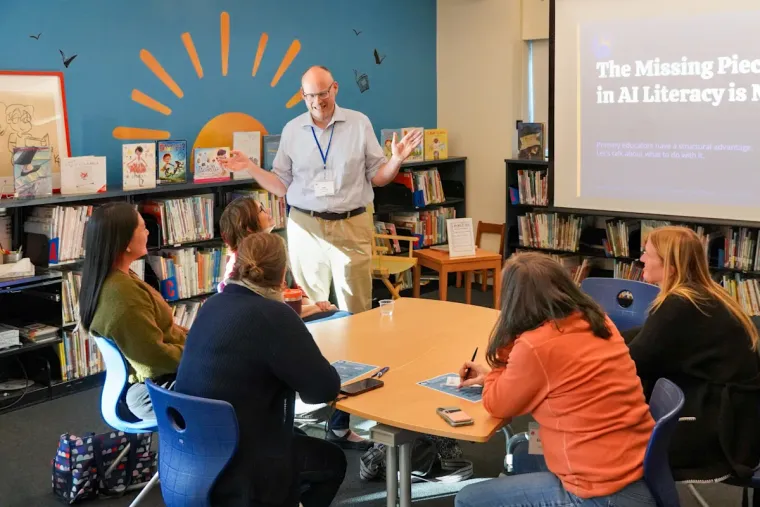
Ian McCullough leading a small-group session on AI literacy at The Learning Frontier, with his title slide visible on screen The Missing Piece in AI Literacy is Math · The Learning Frontier, Mar 2026 →

Original ideas on AI literacy

The Missing Piece in AI Literacy is Math

Built live, in front of the room, at The Learning Frontier

In preparing students for an AI-powered world, primary educators have a structural advantage secondary teachers lack: they are generalists. They teach the same set of students reading, writing, and mathematics. The opportunity has largely been overlooked, so I put together a presentation for a local conference to make the case.

When a skeptical attendee expressed doubts, I asked about what they were teaching the next day. Then, I vibe-coded an interactive heart-rate simulation for them live during the session.

Slides, demos, and the full session →
Bar chart ranking U.S. states by median Learning Connection Time, from about 13 to 47 minutes per student per day

Making a dent in the universe

Research

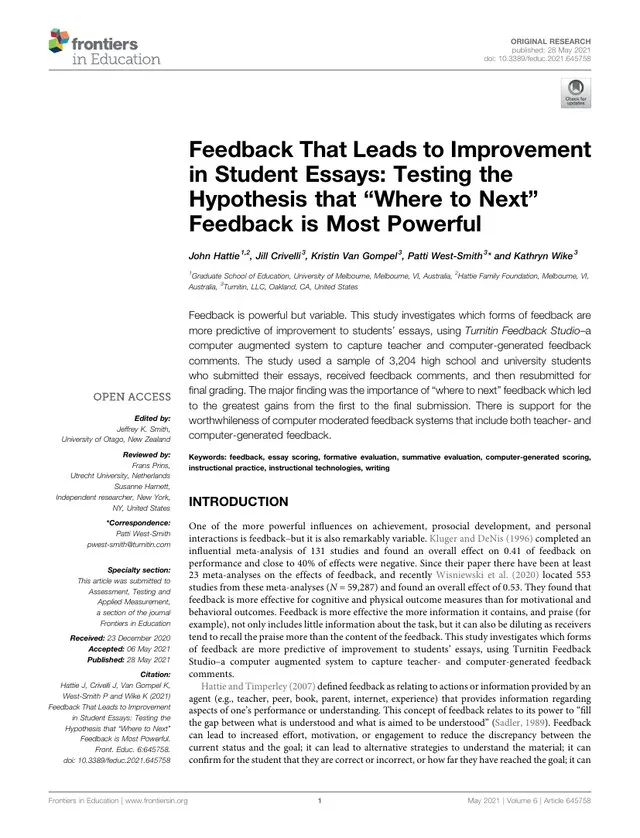
In 2018, as I was starting my six years at Turnitin, I recognized a gap — one that now challenges every company in EdTech. We needed credible, peer-reviewed research to prove that our solution equipped educators to meaningfully improve learning outcomes. After two and a half years of patient and painstaking work, my teammates and I delivered exactly that. In partnership with Dr. John Hattie of the University of Melbourne, one of the most-cited researchers in education, we produced original scholarship on effective feedback that leveraged anonymized student-teacher interaction data from Turnitin Feedback Studio. In March 2021, after we passed rigorous peer-review, Frontiers in Education published the paper.

As this research has added to the body of knowledge that guides great teachers, I consider this one of my career's crowning achievements. You won't find my name on the author line, though — and that was my own choice over the objections of my teammates. Though I orchestrated the project with integrity from beginning to end, I was still a marketer working on behalf of a business. As identifying oneself as a marketer ironically tends to sow doubt rather than inspire confidence, I chose to take my bow from the acknowledgements.

Trust is everything.

Hattie J, Crivelli J, Van Gompel K, West-Smith P and Wike K (2021). Feedback That Leads to Improvement in Student Essays: Testing the Hypothesis that “Where to Next” Feedback is Most Powerful. Front. Educ. 6:645758.

Read the study →
First page of the peer-reviewed Frontiers in Education study on feedback

Presentations & Conversations

Part of a longer run — 20+ webinars and live sessions across AFT Share My Lesson, Education Week, and the Turnitin Educator Network.

Seen enough to reach out?

Get in touch